Monday, May 25, 2020

Heed ceasefire call, UN chief urges, marking Africa Day

Heed ceasefire call, UN chief urges, marking Africa Day

© UNICEF
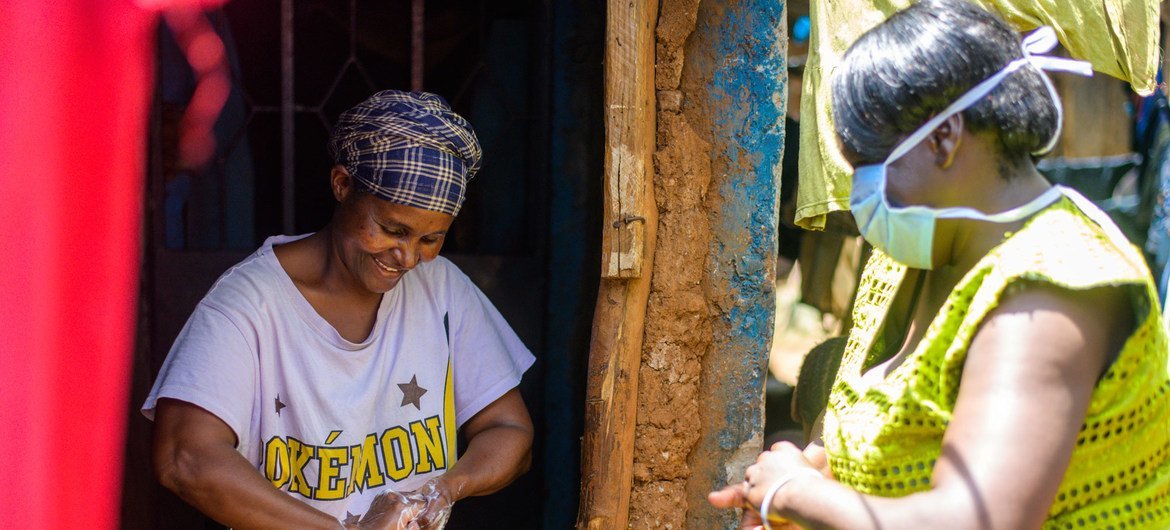
In the Kibera slum in Nairobi, Kenya, residents are provided with soap and water to wash their hands in order to help halt the spread of the coronavirus.
    
24 May 2020

African countries have “demonstrated commendable leadership” battling the COVID-19 pandemic, but more nations across the continent where conflict prevails, should heed the UN call for a global ceasefire to push back the deadly virus, said the Secretary-General on Monday.

Marking Africa Day, António Guterres said in his message that the pandemic “threatens to derail progress” which would enable countries to reach the Sustainable Development Goals (SDGs) and development targets set out in the African Union’s (AU) Agenda 2063.

The AU has established a task force to develop a continent-wide strategy and appointed special envoys to mobilize international support, said the UN chief. Its Peace and Security Council has also taken steps to counter the negative impact of COVID-19 on the implementation of critical peace agreements and reconciliation efforts.

He noted that the Africa Centres for Disease Control and Prevention established a response fund, while African Member States have undertaken “robust measures to contain the spread of the virus and mitigate the socio-economic impacts.”

Mr. Guterres welcomed the AU’s support for his global ceasefire call, an imperative that also reflects the AU’s 2020 theme: “Silencing the Guns: Creating Conducive Conditions for Africa’s Development.”

“Armed groups in Cameroon, Sudan and South Sudan have responded to the call and declared unilateral ceasefires. I implore other armed movements and governments in Africa to do likewise.  I also welcome the support of African countries for my call for peace in the home, and an end to all forms of violence, including against women and girls”, he continued. 

Politics and the virus

Some 20 African countries are scheduled to hold elections this year, some of which are likely to be postponed due to the pandemic, with potential consequences for stability and peace, noted the Secretary-General.

“I urge African political actors to engage in inclusive and sustained political dialogue to ease tensions around elections and uphold democratic practices.”

UN pointers

Last week, the UN issued a policy brief outlining the impacts of the pandemic on the continent: “We are calling for debt relief and action to maintain food supplies, protect jobs and cushion the continent against lost income and export earnings.  African countries, like everyone, everywhere, should also have quick, equal and affordable access to any eventual vaccine and treatment.”

An opportunity now exists, for African governments to “use this moment” to shape new policies that bolster health systems, improve social protection and pursue climate-friendly pathways.  

Targeting measures to those employed in the informal sector, the vast majority of whom are women, will be an important step to recovery, said Mr. Guterres, as will empowering women to ensure their full participation and leadership. 

“The inclusion and leadership of young people will also be crucial every step of the way.”

 Courtesy:UN News

Saturday, May 16, 2020

China’s ‘Erhardian Bargain’


Author: Tristan Kenderdine, Future Risk

The English call it wacky economics, it is at odds with France’s economic philosophy of dirigisme and it has been accused of pushing the European Union into a monetary policy stalemate. Yet German ordoliberalism may have much in common with contemporary economic policy in China.

A worker uses a mobile phone in front of a poster outside a construction site in Beijing's central business area, China 4 February, 2018, (Photo: Reuters/Jason Lee).

The German Historical School of economic theory played a huge part in China’s choice of development trajectory and institutions during industrialisation. The economic logic of China’s reform era model was part Friedrich List, part Alexander Hamilton and part Ludwig Erhard. In Germany, this economic logic would evolve to become ordoliberalism.

East Asian economic development has consisted of a series of exercises attempting to emulate the German experience. These attempts include the ‘East Asian miracle’, South Korea’s ‘Miracle on the Han River’, ‘Taiwan’s Miracle’ and ‘China’s economic miracle’. These aphorisms — almost always inadvertently — refer to the original Wirtschaftswunder, the ‘Miracle on the Rhine’ of post-war German reconstruction. But both globalisation and development economics consistently ignore the contribution of the underlying ordoliberal theory to economic development policy.

The model for industrial development in East Asia requires a national economic system in the first instance. State-capitalist industrialisation drives in East Asia were all dependent on a ‘Lewis model’ of converting an unlimited supply of rural labour into labour for urban manufacturing. Under this labour-for-development model, there is generally a window of around 30 years within which states establish the initial institutions of industrialisation before moving into regional and global trading regimes. Indeed, during each of the 30-year industrialisation windows in Germany, Japan, South Korea and Taiwan, an entire generation was forced to make a sacrifice for the nation.

This national sacrifice required a willing supply of labour to be used for a greater utilitarian good. This is one of the key ingredients of the East Asian industrialisation model: a population of labour that undertook generational sacrifice for future national and generational prosperity. Compared with the early European and American industrialisers that used forced labour to achieve this, the East Asian model is better described as ‘coerced labour’.

This sacrifice is often taken as an acceptable trade-off between governments and their populations. In South Korea, for example, the working generation from 1956 to 1979 suffered immense hardships through rapid industrialisation so that the country could modernise. In East Asian economic history, the political legitimacy mechanism underlying this economic growth period could be described as an ‘Erhardian Bargain’ with rural labour.

The political legitimacy of an Erhardian Bargain is dependent on government achieving industrialisation within one generation. When industrialisation drives fail — like they have in Thailand and Kazakhstan — public discontent that the sacrifice did not result in sufficient capital accumulation necessitates a renegotiation of the bargain.

In China, labour sacrifice has been immense and coastal development astonishingly successful. But the hinterland remains poor, rural development has stalled and many parts of rural China lag behind aggregate development. For example, the seven least-developed provinces in China have per capita incomes under US$7000 a year — that is over 238 million people who are far off the OECD income range.

The legitimacy of China’s Erhardian Bargain is now being put to the test as the economic restart post-COVID-19 hits labour in China hard. Many mid-income salary workers are on half-pay or no pay, many rural migrants have returned to the countryside from urban factory work and new graduates and high-skilled workers are facing an impossible leap in 2020 to reach national science and technology industrial policy goals.

The promise of economic development after a 40-year modernisation project is the backbone of Chinese Communist Party legitimacy. But China’s central leadership may find it difficult to ask rural migrant workers to take another hit for national development, especially after rural families have already sacrificed their children into the urban industrialisation project in the hope of long-term gains that for many have not yet materialised.

The 2020s is the decade that China is due to deliver on its Erhardian Bargain: to eradicate rural poverty by 2020, to achieve a moderately prosperous society by doubling 2010 GDP by 2021 and to establish the economic growth framework to become a developed ‘modern socialist state’ by 2035. But a continuous supply of rural labour is needed to support China’s further economic growth and development. It is not as simple as turning the machines back on if structural elements of labour were to drop out.

The central leadership in Beijing already has a huge task to transform the Chinese economy into one driven by consumption, imports, outbound FDI investment and high-technology. This would have been an economic pirouette of the highest dexterity even in reasonably good economic years. To achieve it this year — given low-to-no growth, a developing labour crisis and a possible debt crisis on the horizon — appears to be a step too far.

Even before COVID-19, the contemporary debate in China’s macroeconomic policymaking circles was already between stimulus and austerity. The project to integrate China into the global economy has stalled and may need a new theoretical framework to both redefine China’s domestic economic policy and international macroeconomic guidelines. In the post-COVID-19 economic restart, there may not be another ‘miracle’. The policy uses of both Listian national economics and the ‘Erhadian Bargain’ of a generation of rapid growth have now expired. Perhaps a contemporary Chinese version of ordoliberalism could provide the policy tools to maintain economic growth.

Tristan Kenderdine is Research Director at Future Risk, based in Almaty.

Courtesy:East Asia Forum
Saturday, May 2, 2020

The geopolitical contours of a post-COVID-19 world


Author: Deepanshu Mohan, OP Jindal Global University

While the impact of the COVID-19 pandemic on the global economy is more dramatic than any other shock in recent history, the consequences of the virus for the geopolitical order could be even more consequential. A radical shift in the global political economy may be imminent in the post-COVID-19 world.

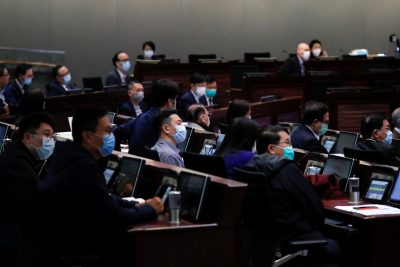
Legislators wear masks to avoid the spread of the coronavirus disease (COVID-19) during the Legislative Council's House Committee meeting, in Hong Kong, China 24 April, 2020 (Photo: Reuters/Tyrone Siu).

This shift is conditional on two factors. The first factor is the relative degree of economic recovery seen in nations affected by the pandemic. The second factor is the very different domestic political scenarios that now exist in many affected nations.

Before the pandemic, populism — and its coercive authoritarian tendencies which see the nation-state strengthen in a backlash against the multilateral-globalist order — was on the rise. The outbreak of the pandemic has provided an opportunity for most states to either increase or retract multilateral cooperation.

As the crisis unfolds, critical multilateral arrangements like the G20 are not presenting a unified front. The United States and China have also faced criticism for displaying weak global leadership.

The United States under President Donald Trump is showcasing an inability to lead efforts to fight the virus, let alone offer necessary aid to other countries. Instead, the United States has threatened to undertake protectionist measures to restrict exports of essential medical equipment to neighbours like Canada. Trump is also halting US contributions to the World Health Organization (WHO).

China, on the other hand, has utilised the opportunity to push its state-propaganda internationally, while emerging as a ‘costly’ global supplier of medical equipment. Despite providing for the increased short-term demand for medical supplies, China has continued to receive severe criticism for its information censorship.

In a post-COVID-19 world, many developed nations may consider disentangling direct trade relations with China and decoupling supply chains to restrict the flow of goods and services into and from China.

Monday, April 13, 2020

UNCDF Tanzania working for poverty alleviatton through working with local organisations

Kigoma is the poorest region in Tanzania and is one of only two regions in the country where poverty rates increased between 2001 and 20121.

To work to reverse the trend, UNCDF Tanzania has been implementing a programme since 2017 to improve agricultural livelihoods, provide access to finance, and build financial and digital literacy in the region.


In the region, UNCDF is working with a number of international and local NGOs to develop and deliver financial education. While UNCDF has been working with the Danish Refugee Council (DRC) and Good Neighbors Tanzania (GNTZ), we have recently begun working with two new local organizations to reach more farmers and members of the Tanzanian community.


One of the new local organizations is the Kigoma Youth Agricultural Development Organization (KIYADO), a local non-profit humanitarian organization that plans, implements, and raises funds for implementing livelihood projects. Another is the Ministry of Agriculture Training Institute (MATI), a government institution under the Ministry of Agriculture of Tanzania that provides educational programs in agricultural, environmental, and applied technologies.


To train the two new partners on the UNCDF package of financial education materials and to work together to create a plan on disseminating materials and continuing financial education activities, UNCDF held a one-day Training of Trainers (ToT) workshop on 5th March in Kibondo, a town in the Kigoma Region. 19 participants from KIYADO and MATI attended the training.

Sunday, April 12, 2020

COVID-19 threatening global peace and security, UN chief warns


Giles Clarke
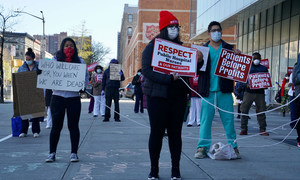
Nurses and healthcare workers outside at a hospital in New York City demand better protection against the COVID-19 virus.
    
10 April 2020

While the COVID-19 pandemic is first and foremost a health crisis, its implications are more far-reaching and could threaten global peace and security, the UN Secretary-General told members of the Security Council in a closed video-conference held on Thursday.

António Guterres said heightened solidarity is needed if the world is to defeat the crisis, which he called the "gravest test since the founding of this Organization", with Governments already struggling to address rising unemployment and economic downturn.

"But the pandemic also poses a significant threat to the maintenance of international peace and security -- potentially leading to an increase in social unrest and violence that would greatly undermine our ability to fight the disease", he warned, later stating that the Council’s engagement will be critical to mitigate these implications.

"Indeed, a signal of unity and resolve from the Council would count for a lot at this anxious time", he said.

Wide-ranging thre

Corona virus restrictiions and UN strategy

UN health agency working on strategies to gradually lift COVID-19 restrictions

UN Photo/Evan Schneider
A wide view of Grand Central Terminal with an unusually sparse crowd during the Coronavirus (COVID-19) outbreak in New York City.
    
10 April 2020

The World Health Organization (WHO) is working with countries on strategies to "gradually and safely" ease stay-at-home restrictions aimed at containing the spread of the new coronavirus, agency chief Tedros Adhanom Ghebreyesus told journalists on Friday, though he cautioned against any sudden action.

"WHO wants to see restrictions lifted as much as anyone", he said.

"At the same time, lifting restrictions too quickly could lead to a deadly resurgence. The way down can be as dangerous as the way up if not managed properly".

Tedros laid out six factors for consideration, which include that transmission is controlled and sufficient public health and medical services are available.

Thursday, March 26, 2020

Debt relief milestone in Somalia, as World Bank, IMF, call for global payment suspension in light of COVID-19


Debt relief milestone in Somalia, as World Bank, IMF, call for global payment suspension in light of COVID-19 

WFP/Georgina Goodwin
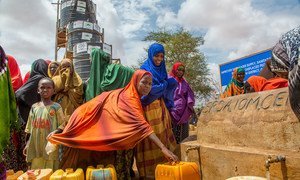
An IOM supported piped water supply project in a displaced persons camp in Dolow, Somalia. IOM, WFP and other agencies were able to cover the urgent needs of the displaced people in this camp thanks to the support of UNCERF.
    

25 March 2020
The top United Nations official in Somalia congratulated the Horn of Africa nation on Wednesday for achieving the benchmark set by the World Bank and the International Monetary Fund (IMF), confirming its eligibility for debt relief. 
James Swan, Head of the United Nations Assistance Mission for Somalia (UNSOM), said that by reaching the so-called “decision point” for debt relief under the Highly Indebted Poor Countries’ Initiative (HIPC), Somalia has passed an historic milestone on its path to peace and prosperity. 

An historic milestone today on ’s path to peace and prosperity: the country has reached the Highly Indebted Poor Countries Initiative’s (HIPC) ‘Decision Point’ for debt relief. Read more: https://bit.ly/2vN2OKL 

View image on Twitter

40 people are talking about this
“Achievement of the HIPC decision point is a major step forward for Somalia’s economic progress, allowing the country to advance towards its long-term objective of inclusive economic growth and poverty reduction,” he said in a statement. 
“All Somalis can be proud of this achievement,” he added. 
The development is welcome news for Somalia – which is carrying $5.2 billion of debt - as it prepares for one-person, one-vote elections later this year against the backdrop of extreme humanitarian challenges. 
Some 5.2 million are in need of assistance, alongside ongoing attacks by the Al-Shabaab terrorist group and the worst locust outbreak in 25 years. 

Global debt relief call: World Bank, IMF 

It also coincided with a call by the World Bank Group (WBG) and the IMF for all official bilateral creditors to suspend debt payments from the world’s 76 poorest countries and enable them to redirect funds towards confronting the economic fallout from the COVID-19 pandemic. 
In a joint statement, the two Washington-based institutions also asked leaders of the G-20 leading economies to task them at their spring meetings on 16 to 17 April with assessing the impact and financing needs of each of the countries, which are part of the International Development Association (IDA). 
Mr. Swan, who is also the Secretary-General’s Special Representative for Somalia, said that the country’s debt breakthrough was testament to the federal authorities’ ability to manage public finances.  “It also reflects strong collaboration between the Federal Government and the federal member states,” he added. “The World Bank Group and the IMF believe it is imperative at this moment to provide a global sense of relief for developing countries as well as a strong signal to financial markets,” it said. 
The World Bank and the IMF established the HIPC Initiative in 1996, to ensure that no poor country finds itself in a situation in which it cannot service and manage its debt burden. 
Reaching “decision point” not only confirms Somalia’s eligibility for debt relief, but also fully normalizes its relations with international financial institutions.  It will also now qualify for certain types of grant financing to meet its public finance and development needs and to access private-sector financing instruments. 
The second and final step after decision point, known as the completion point, would open the way for full and irrevocable reduction in debt under the HIPC Initiative. 
In a press release, the IMF said debt relief for Somalia – the 37th country to reach decision point – would help it make last change for its 15 million people by allowing its debt to be irrevocably reduced from $5.2 billion at the end of 2018 to $557 million once it reaches completion point in about three years’ time. 
Cour

Heed ceasefire call, UN chief urges, marking Africa Day

Heed ceasefire call, UN chief urges, marking Africa Day © UNICEF In the Kibera slum in Nairobi, Kenya, residents are provided with soap and ...